
ART | EXHIBITION | SURABAYA | 2026
Born from a sense of collective anxiety and the exhaustion of living under the constant demand to be productive, Artchemist—an art event organizer and media platform—in collaboration with Tujujati Art Space, presents an exhibition titled “The Right to Slow Down.” Hosted at Kammari on Jalan Ketintang, Surabaya, the exhibition opened on January 24, 2026, and will run until February 25, 2026.
In the curatorial essay, Athia Alamanda notes that in an era where everything is forced to move faster, vital questions emerge: Is there still room to slow down? Do we still have the right to observe the details we so often overlook? How do we nurture small joys into collective happiness before everything “rots and rusts”? For me, these questions sparked an even deeper curiosity after witnessing the works on display.
The exhibition features twelve artists from various cities: Ach Soiful, Ara W.A.F., Arsya Deananda, Aumlukov, Benny Cahya, Deden S. Yogi, Dwiki Nugroho Mukti, Katitis R., Muzeian, Pandu S.D., Rahayu Riza, and Shohifur Ridhoi.
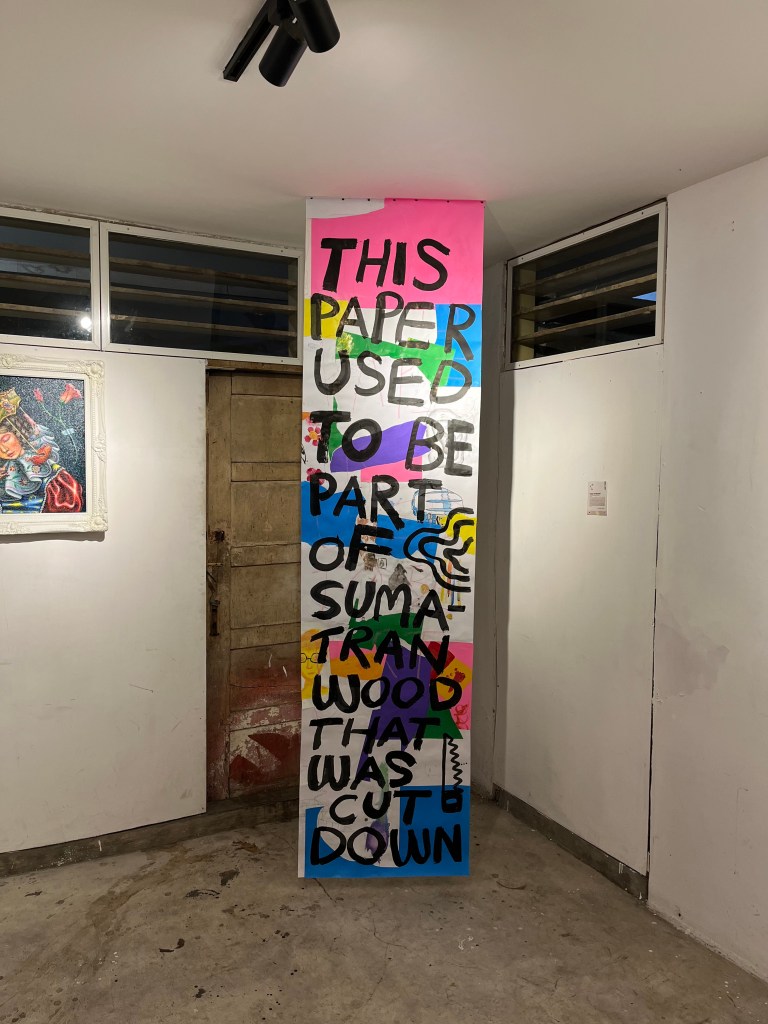
Inside the “white cube” of the gallery, several works immediately demanded my attention. The first was by Dwiki Nugroho Mukti. A bold statement—“THIS PAPER USED TO BE PART OF SUMATRAN WOOD THAT WAS CUT DOWN”—written in black ink on a paper collage, hangs from the ceiling to the floor. Titled “Cause of Disaster,” this piece feels painfully contextual, echoing the recent floods that devastated Sumatra due to rampant deforestation. As a consumer, the work felt like a sharp sting. While the conversion of primary forests into industrial timber seems unstoppable in this era, our role as consumers remains crucial. Every wasted sheet of paper accelerates the destruction of the Earth’s lungs.
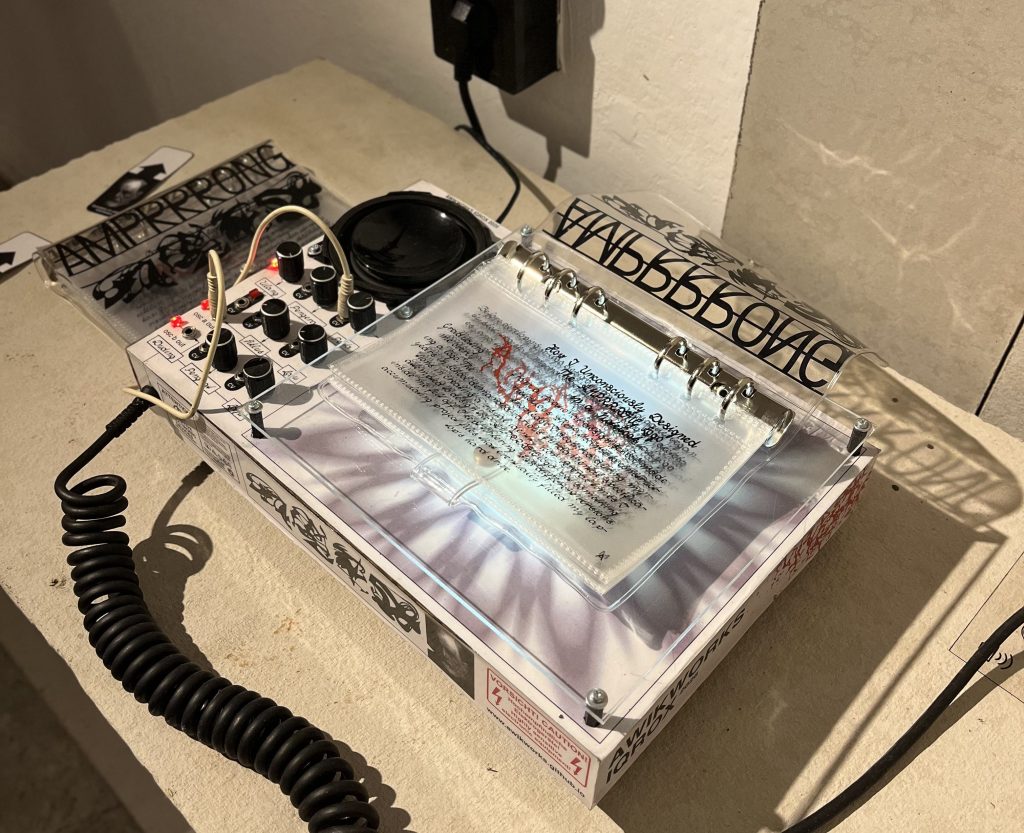
The narrative of slowing down shifts from the ecological to the interactive in Muzeian’s new media work. In a corner of the room, a glowing semi-modular synthesizer hums with sound. Named “Awikworks Iqrox,” this instrument is not designed for precision or mastery, but for slow, deliberate exploration. Visitors are invited to turn knobs, plug in patch cables, and listen to the shifting sounds guided by a transparent booklet. This piece effectively forces the viewer to decelerate through physical interaction.
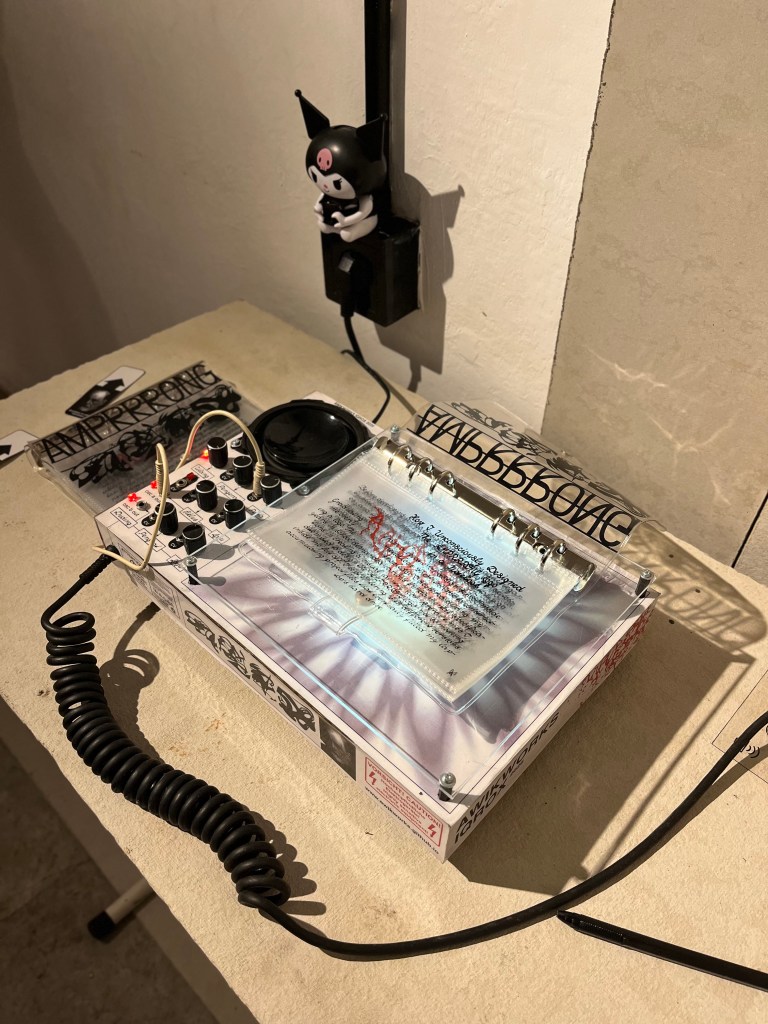
For Muzeian, the process of slowing down—the very theme of this exhibition—was applied personally as he took the time to revisit his old writings. Through this process, he rediscovered ideas that were written without the pressure of being “immediately useful” or finished. It led to a profound realization: old ideas are still alive, capable of evolving into entirely new forms.
Further into the space, Shohifur Ridho’i’s installation, “How Time Walks, How Time Flies,” offers another perspective on temporality. His photography is printed onto acrylic and fabric, hung like window curtains, creating a layered experience of time.
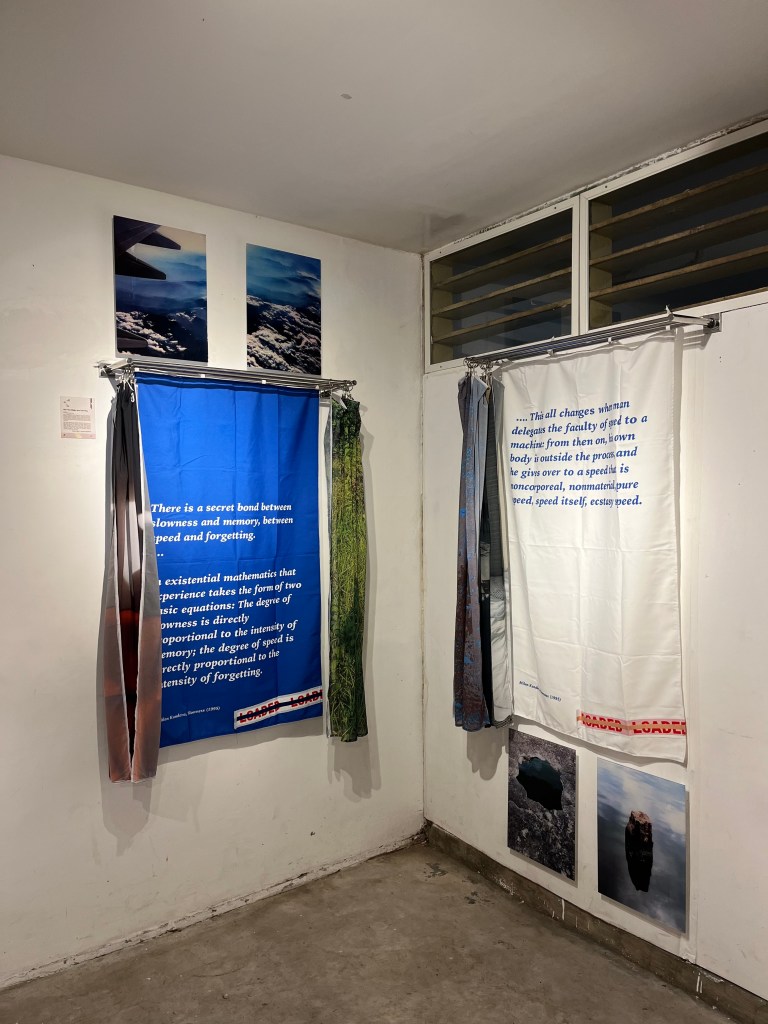
By contrasting two modes of time, this artwork explores the tension between haste and hesitation. An aerial perspective represents the experience of speed; here, distance is condensed into a momentary path that barely settles in the mind. Conversely, snapshots from a walk record slowness as a physical, grounded practice. Drawing from Milan Kundera’s philosophy, the work examines the intimate bond between acceleration and forgetting. These images serve as a visual inquiry into our modern ‘politics of time,’ asking whether our relentless rush is stripping us of our memory, and if slowness can offer a space to reclaim it.
However, as I stood in the quietude of the gallery, a sharper set of questions began to pierce through the contemplative silence. Do we truly live in a world where we are “demanded” to be productive, or is that demand merely a symptom of a much deeper, structural fracture? Who is the one demanding? And since when did the simple act of existing become a race we never signed up for? We often frame our inability to slow down as a personal failure or an individual reluctance, yet we ignore the glaring economic reality: for many, one job is no longer enough to sustain a life. In a broken economy, “productivity” isn’t a choice—it’s a survival reflex.
In this context, we must recognize that an exhibition does not need to provide a tangible solution to be meaningful. Its true power lies in its capacity to spread awareness and open a space for public dialogue that is otherwise stifled by the noise of the daily grind. By bringing these hidden anxieties into the gallery, “The Right to Slow Down” serves as a crucial catalyst. It doesn’t offer a manual for economic reform, but it fosters a collective realization: that our exhaustion is not a personal void, but a systemic symptom that deserves to be questioned out loud. Ultimately, the exhibition succeeds in reclaiming the ‘right’ to slow down as a vital human necessity. But until we address the systemic gears that force us to run, for many, this right will remain a contested luxury—a quiet defiance that we must continue to negotiate within an unyielding economy.
 readesignmagazine.com
Leave a comment