
DESIGN | WORKSHOP | SURABAYA | 2025
Amidst the rapid pace of technology and industry today, is the state of the design field heading toward a utopia or a dystopia? What exactly does it mean to be an interdisciplinary designer in this new reality, and what significant role must the design learning process play in achieving it?
On October 3, 2025, ADGI SUB (Indonesian Graphic Designers Association Surabaya Chapter) collborated with Butawarna Studio and Further Reading hosted a public discussion session at C2O Library, Surabaya. Titled ‘Yip Yapping on Design Education’ and featuring Januar Rianto from Further Reading and Andriew Budiman from Butawarna Studio, the event was part of the book release tour for Further Reading Press No. 4: Learning Within, Learning Without (Modes of Design Enquiry). The next day on October 4, 2025, Butawarna Studio initiated a workshop titled ‘Introduction to Detoxing Design’ and collaborated with Further Reading.
About Andriew Budiman and Butawarna Studio
Andriew Budiman is a designer, active in the design community as the principal of butawarna studio, visual director of C2O library, and general secretary of PERIN+1S. He has been a board member of ADGI Surabaya Chapter since 2010. In 2011, he initiated and curated the annual interdisciplinary design event, Design It Yourself (DIY-SUB), later renamed the Surabaya Design Summit. Recognized for his contributions, Andriew received the Indonesian Graphic Design Award for Socio-cultural Achievements in 2017. His design works and writings have been published and exhibited both locally and internationally.
Butawarna is a small design unit based in Surabaya, Indonesia. It focuses on co-producing suitable design and medium outcomes with other entities, with the aim of advancing design practices and dialogues.
About Januar Rianto and Further Reading
Januar Rianto is a designer, editor, and publisher whose work critically explores the intersection of design, education, and popular culture. After his studies in London, Treviso, and Tokyo, he established a practice that views design as a critical framework for seeing the world. He manages three key ventures: Each Other Company (an interdisciplinary design practice), Further Reading (a risograph studio and publishing platform), and the annual Jakarta Art Book Fair. Rianto is an awarded member of the International Society of Typographic Designers.
Further Reading is an independent, multi-format Indonesian publishing platform focused on production and distribution. Its core mission is to stimulate global and local design discourse, particularly in Southeast Asia, by exploring the wider context of design through various programmed experiences, including online and printed publications, pop-ups, and workshops.
Yip Yapping on Design Education
The discussion session was primarily attended by design students and practitioners. To start, Januar Rianto introduced Further Reading and provided a brief explanation of the essays in the Further Reading Press No. 4 book. Subsequently, Andriew Budiman shared the backstory of his contribution, ‘Design Pedaggedon: Utopian Daydreams in Today’s Dystopia,’ and offered more detail on the subject.
After the Q&A session—which primarily focused on the audience’s curiosity regarding design education (both Indonesian and foreign) and the professional design industry—I posed a few questions to the speakers. I asked Januar Rianto to elaborate: ‘In the editorial approach, you stated that it’s important for a designer to learn other disciplines like politics and philosophy, rather than just the design discipline itself. What are the concrete differences in practice between an interdisciplinary designer and one who is not?’ I then turned to Andriew Budiman, asking: ‘In your essay, you mentioned ‘The Six Hats of A Complete Designer.’ Can you elaborate on what that is for the audience today?’
After providing their answers, Andriew mentioned that the discussion initiated by Butawarna Studio would continue the following day in a workshop with limited seating, which would delve deeper into questions similar to the ones I had just posed.
Introduction to Detoxing Design Workshop
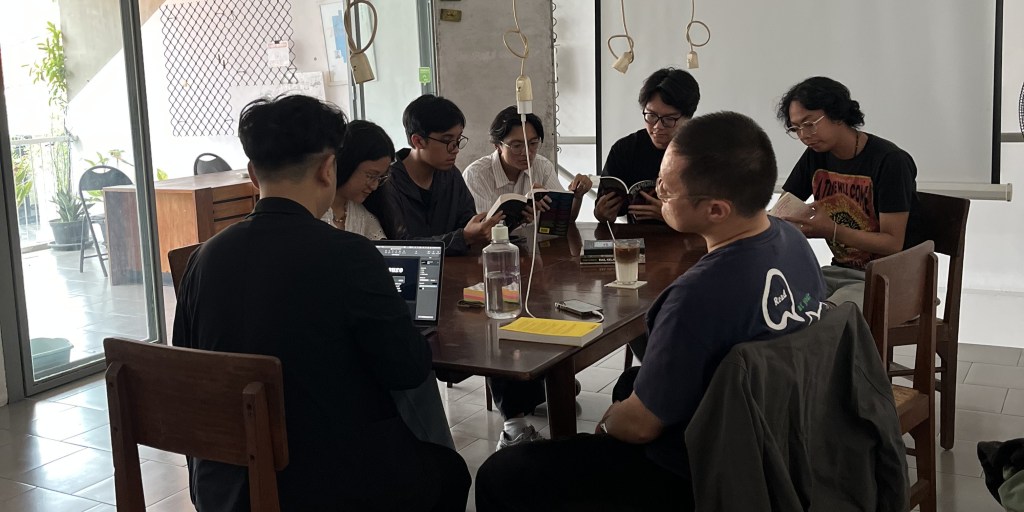
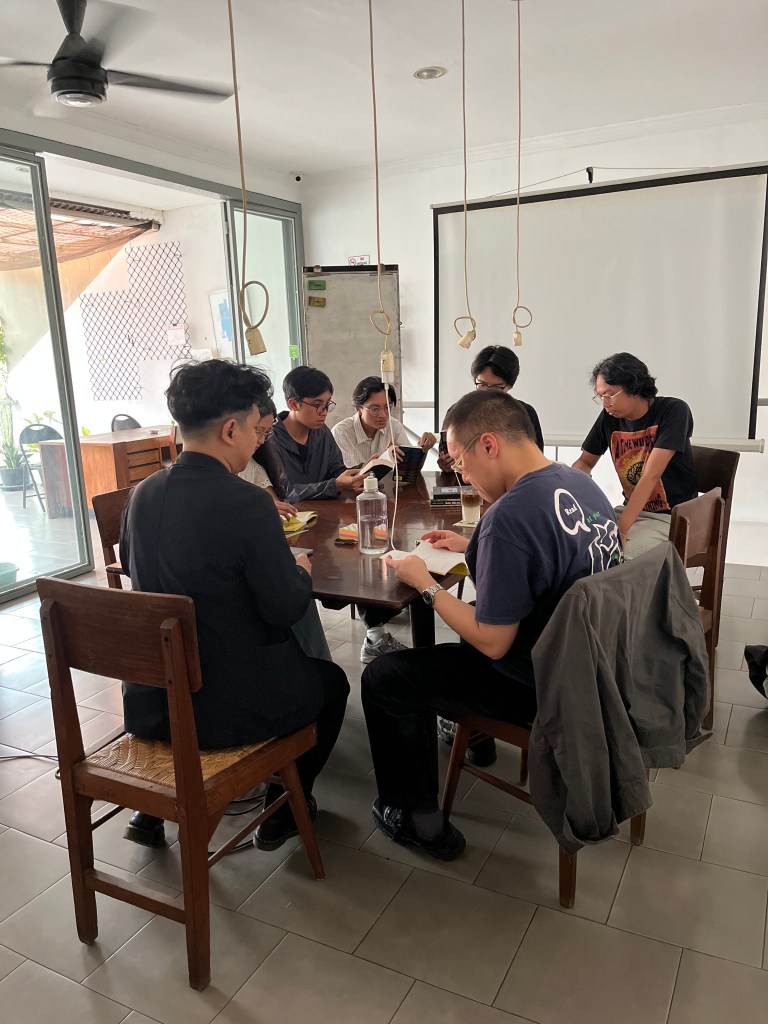
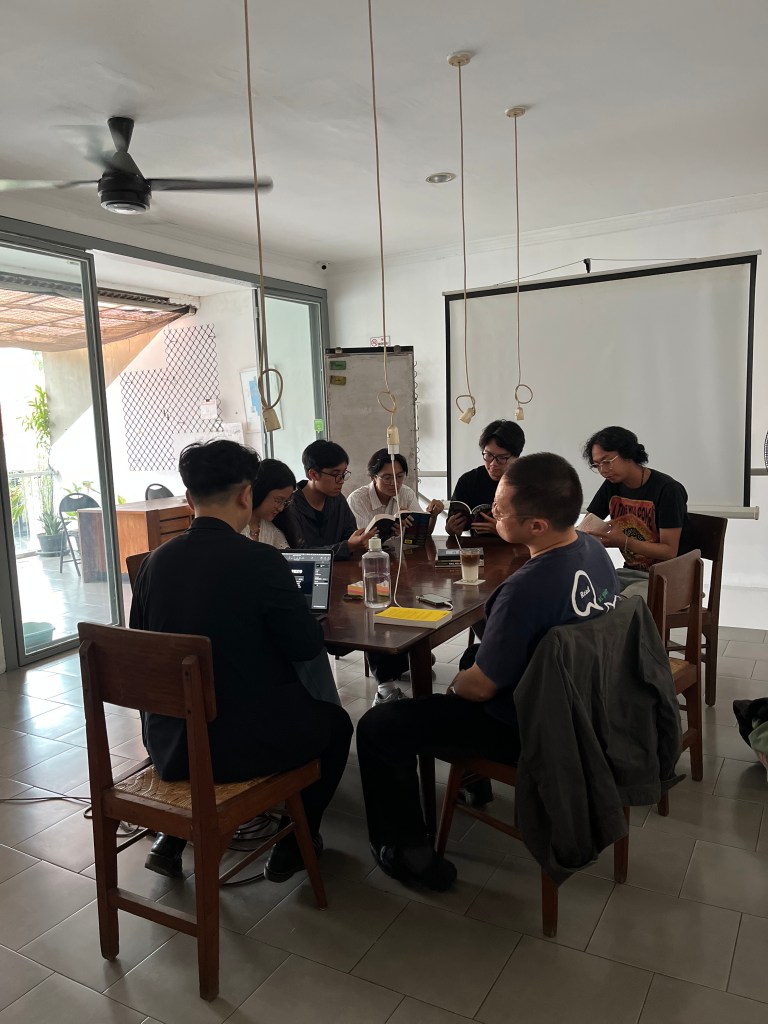
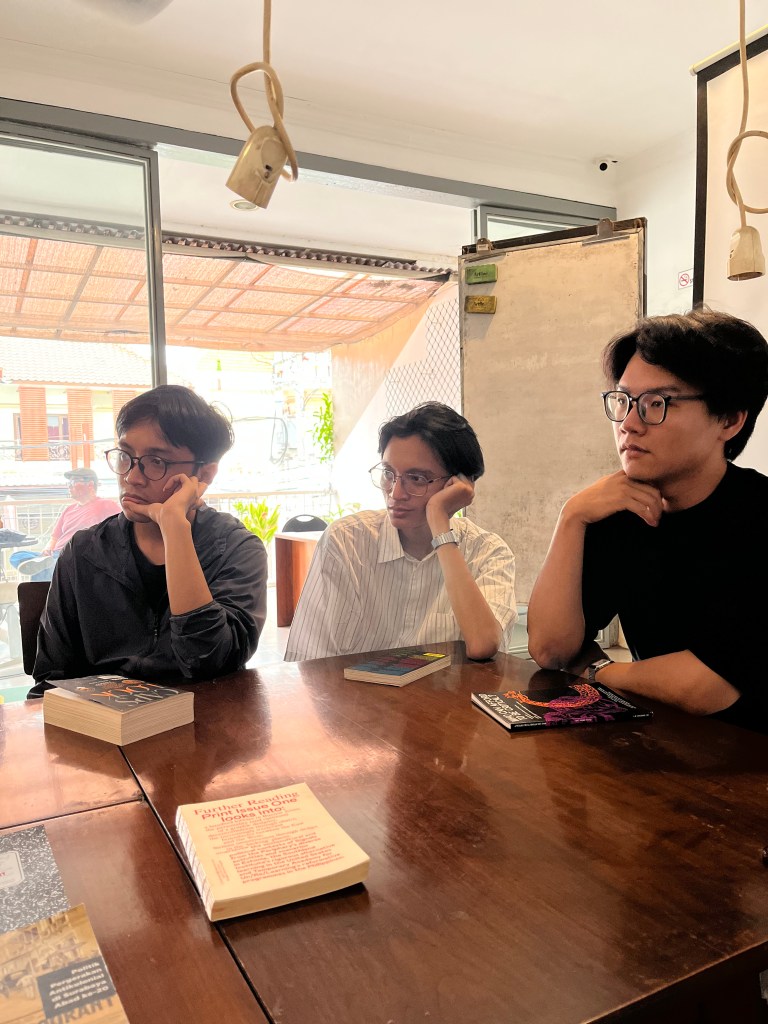
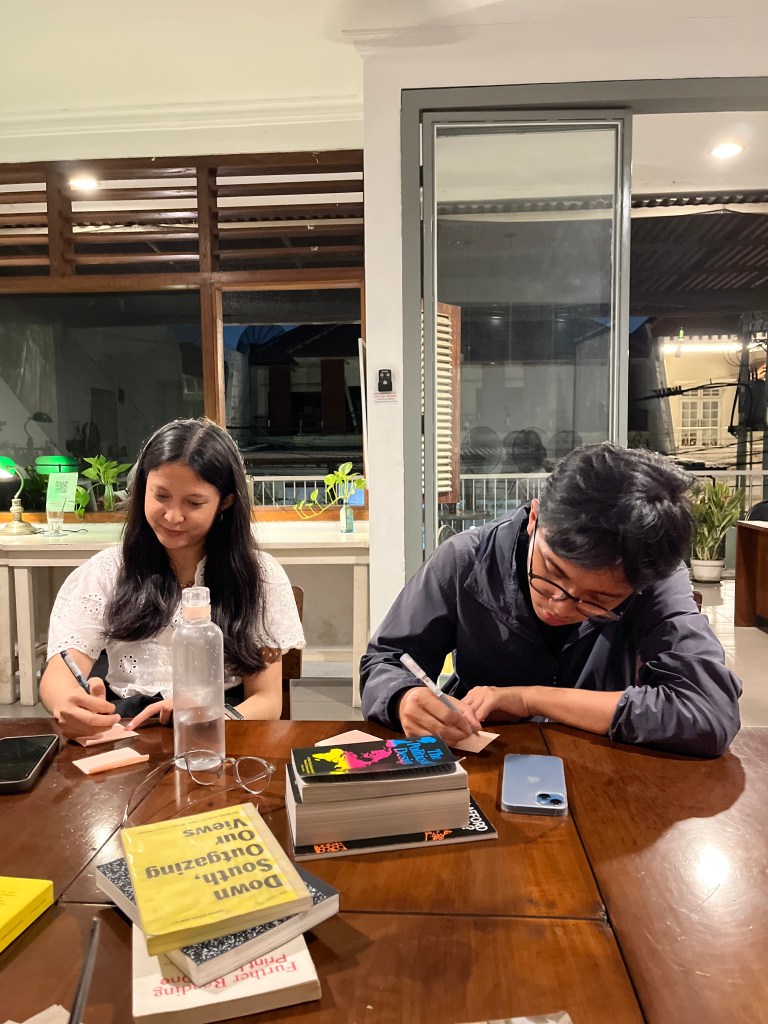
The subsequent workshop, attended by a small group consisting of three design students, a design lecturer, and one design practitioner, commenced the following day. Andriew, Januar, the participants, and I gathered around a table adorned with design books that Further Reading brought. Andriew began the session by clarifying that the event wasn’t a ‘craft’ workshop designed to produce physical output, but rather a reflective support group discussion meant to help participants know, realize, and recognize the inherent toxicity within the design world today.
Design as a Primordial Human Act
After the introductions, Andriew immediately challenged the ‘creative class’ jargon, which he traced to government promotion around 2009. He argued that this jargon placed designers on a false pedestal. Instead, he proposed that if design is problem-solving, it is a primordial and inseparable human act, much like the survival instinct. To illustrate, Vini shared Kenny Hartanto’s research on the design of traditional satay stalls and how people in a fisherman’s village use a kerai (bamboo blind) to counteract the heat. Meanwhile, Januar noted the common sight of soto sellers bending spoons to hang on the sambal bowl. Januar affirmed that these spontaneous solutions were indeed design processes. That is why he held this kind of workshop: to reflect on our own bias as designers and realize that the design discipline cannot stand alone.
Obsession with Growth
Andriew opened the discussion by observing the modern obsession with unlimited growth and convenience. We noted that this growth is largely economic and often achieved by exploiting both the environment and people. The core question emerged: How much growth is enough, given Earth’s finite resources? Must we really wait until the planet is uninhabitable to become mindful?
To contextualize this, I shared my research experience in a fisherman’s village in Gresik. I witnessed firsthand how industrial takeover polluted the coastal air and seawater. Listening to the local fishermen’s struggles made me acutely aware of my own privilege; my lack of direct exposure didn’t negate the climate crisis.
This ecological concern mirrors a fear in the design world: that technology and AI will soon replace graphic designers. We collectively agreed this is false because design is not simply a software skill, but a complex act of problem-solving based on context, which became the focus of our subsequent conversation.
Dystopian Reality
Have we already entered a dystopia?
We agreed the current reality is stranger than fiction. Andriew recounted how the distance we once felt from fictional events has vanished; now, we see reports of people marrying AI or ending their lives over a fictional character’s death. Technology is growing too quickly, leaving us no time to contemplate or use it mindfully. The workshop’s goal wasn’t to reject technology, but to promote mindful usage. True mastery of AI, Andriew argued, is not about prompting skills (which is just usage). Mastery means leveraging the tool while remaining aware that every prompt costs resources and ensuring we retain our human empathy. This technological speed has unfortunately reduced design to a mere craft—a focus on aesthetics and software skills—rather than recognizing it as a complex problem-solving language.
Design is A Language
During registration, participants were invited to submit discussion questions. Exploring these inquiries revealed that at least one participant was actively questioning the value of the discipline, asking: “Is design truly vital for community development?” This concern was validated by others in the small group, highlighting that many students are facing similar internal debates, asking: “How much can design actually help people?”
We theorized that this profound doubt among students and practitioners originates from the failure of professionals and educators to teach design as a complex, language-based process rather than merely a visual output.
Clara, a design lecturer, supported this view, explaining that she always teaches design within its wider context. To address the participants’ queries, she recommended several books that could expand their vision of design such as The Politics of Design, emphasizing that design holds the power to either significantly benefit a community or, conversely, destroy it.
The Seven Hats of Complete Designer
In his essay, ‘Design Pedaggedon: Utopian Daydreams in Today’s Dystopia,’ Andriew presented his theory, ‘The Six Hats of a Complete Designer.’ This theory stemmed from his observation that designers often overlook the importance of words, prioritizing merely the visual aspect—a fundamental mistake in his view. He emphasized this point by stating: “Design is about comprehensive thinking that begins in the mind, and words are the vessels that transport ideas.”
He detailed the seven roles (revised from the original six) a complete designer must embody: investigator, analyst, editor, writer, translator, crafter, and critic. Andriew asserted that integrating these roles brings clarity and mindfulness to a process that currently skips directly to the ‘Crafter Hat’ and avoids the ‘Critic Hat.’ He concluded that many designers face burnout precisely because they bypass the crucial initial five hats, stressing that while perfection is unattainable, the effort to engage all seven roles is paramount.
Interdiciplinary is Mandatory
Building on Januar’s point about studying outside the design field, combined with Clara’s intercontextual teaching methods and the Seven Hats theory, we concluded that interdisciplinarity in design practice is mandatory. The core argument is simple: individuals who operate daily within their context—be they engineers, biologists, or chefs—possess expert knowledge. Consequently, designers must learn their context to design anything effectively related to their work. The imperative is clear: Designers must actively seek out other communities, not just other designers, to recognize and challenge their inherent biases.
A Starting Point
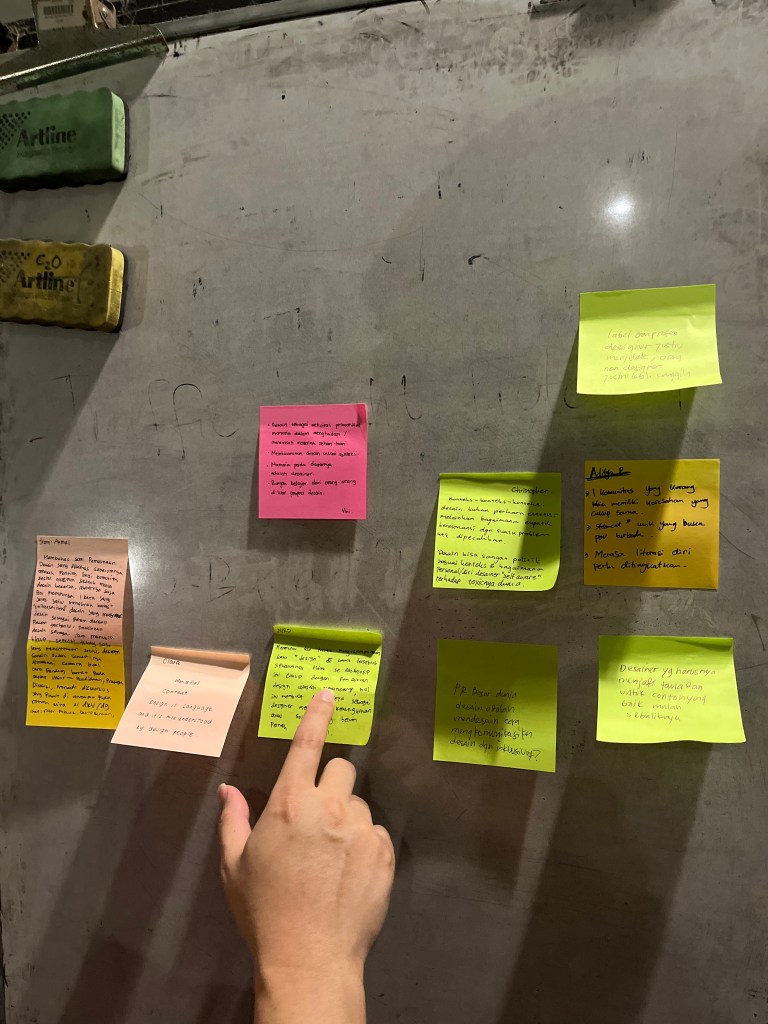
In line with the title, ‘Introducing to Detoxing Design,’ Andriew clarified that the session was just a starting point. Its goal was not final solutions but to ignite deeper conversations about current design practice and education, and to promote self-reflection among designers. Expressing a wish for future regularity, he hoped similar workshops would be held more often. The session closed with a final reflective exercise: Andriew asked all participants to quickly summarize their takeaways on a sticky note and affix it to the whiteboard.

 readesignmagazine.com
Leave a comment