
ART | EXHIBITION | GRESIK | 2025
What if the city we inhabit turned out to be a wild mental zoo? What kinds of creatures and energies would dwell within it, and how would they interact?
Das Genesis (Ayudhia Virga and Yura Kenn Kusnar) explores this question in Bestiarium Mentis, a new media exhibition that reimagines Gresik City as a savage psychic ecology inhabited by imagined mental beings. Curated by Ayos Purwoaji, the exhibition ran at Loteng Gallery, Gresik, from September 19–21, 2025, as part of the 11th Sesarengan East Java Biennale.
About Das Genesis
Das Genesis held their debut solo exhibition Room 404 at Sewu Satu Gallery, Jakarta (May 17–June 15, 2025), curated by Amanda Ariawan. As a new media art collective, they are known for creating work outside conventional art spaces. Their practice merges sound, technology, and raw materials to forge alternative worlds—imagined spaces that challenge the established truths of our own. Bestiarium Mentis is their second solo exhibition.
The Concept of Bestiarium Mentis
Before attending the exhibition, I researched the words bestiarium and mentis. The term immediately reminded me of Arthur Spiderwick’s Field Guide to the Fantastical World Around You by Holly Black and Tony DiTerlizzi—an encyclopedia of real and imaginary creatures written with such conviction that one almost believes in their existence.
Had I skipped the book’s opening section, skepticism might have taken over: Are these creatures real? Yet the descriptions were so persuasive. The opening, however, included one memorable line: reality or unreality depends on perception. Considering the vastness of the universe and the limits of human capability, I believe possibilities beyond reason must always exist.
By definition, a bestiarium (bestiary) is a compendium classifying both real and imaginary creatures. Popular in the Middle Ages for educational and moral purposes, bestiaries often used allegory—employing animals as symbols to convey spiritual or philosophical truths. In contemporary contexts, the genre has evolved into a creative framework for imagining fantastical beings.
Meanwhile, mentis (Latin, genitive of mens) means “of the mind” or “pertaining to intellect.”
With this background, my anticipation for Bestiarium Mentis centered on how the exhibition would portray Gresik as a “mental zoo”—how Das Genesis’s works would engage with the city’s unique psychic energies inside Loteng Gallery’s compartmentalized space and within the atmosphere of Kampung Kemasan.
Exhibition Opening and Artist Talk
Because the exhibition lasted only three days, the opening doubled as an artist talk before the public entered the viewing area. Curator Ayos Purwoaji introduced the event and guided a conversation with Das Genesis, in which Ayudhia Virga and Yura Kenn Kusnar explained the exhibition’s conceptual origins.
Ayudhia recalled his first impression of Gresik as a site of “collision of realities,” where diverse architectural styles coexist without erasing one another. Yura agreed, noting how in areas like Sualoka (Kampung Kemasan), buildings resist easy classification, with the starkly different atmospheres of their first and second floors.
Regarding the collective itself, Yura clarified that while they never fixed a single definition, they are best described as a new media art collective. Their interdisciplinary practice draws references from film, music, and philosophy. Yura added that his shift away from painting came from its limitations: combining other disciplines with traditional mediums allowed unexpected outcomes. For him, this element of surprise makes the creative process compelling.
Exhibition Tour and Artwork Review
Once the talk concluded, Ayos led the curatorial tour. Visitors were greeted first by The Story of Macan Kemuning, a digital print paired with a video installation, placed near Ode to Acton.
The Story of Macan Kemuning
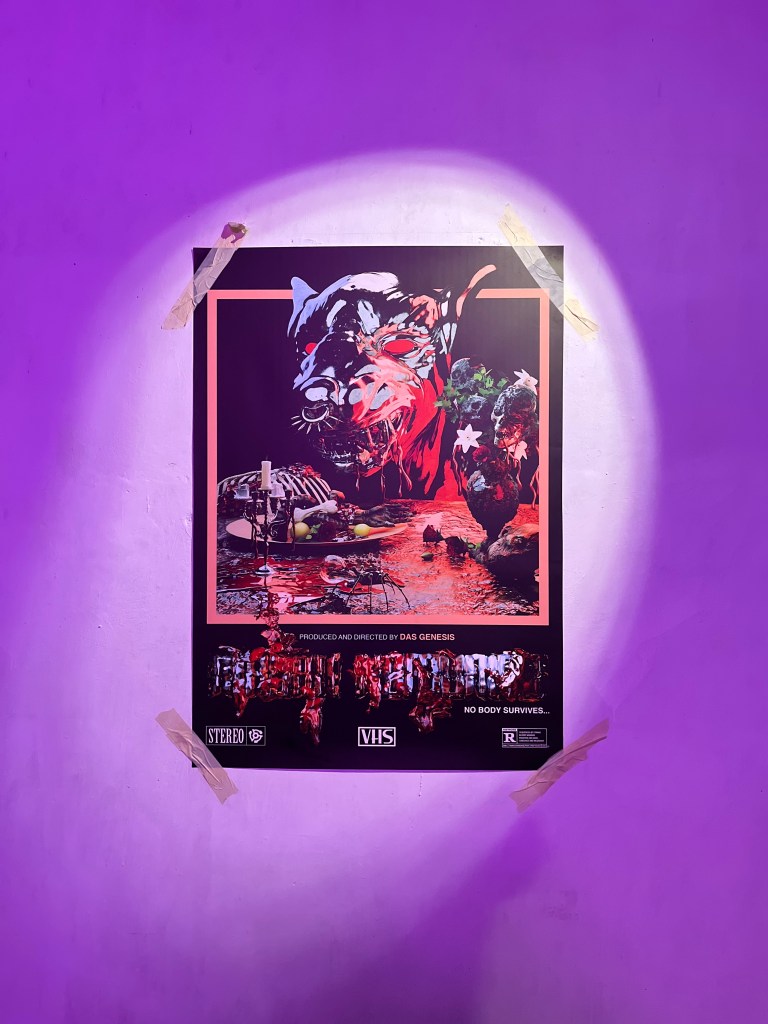
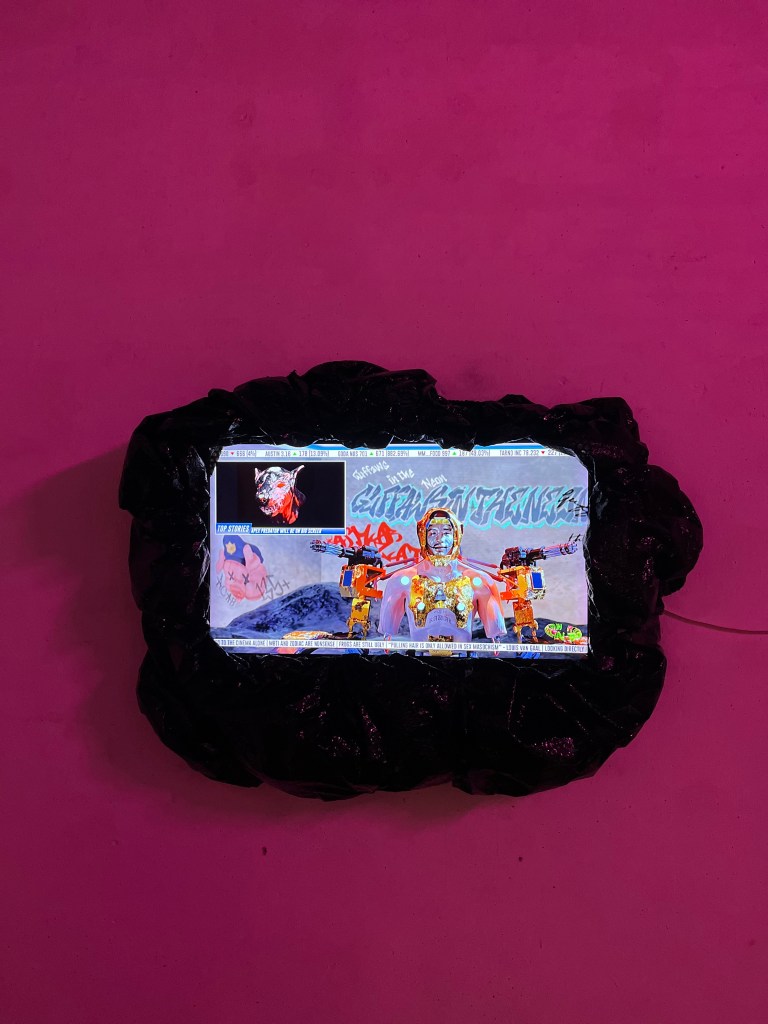
The video installation presents a 3D digital newsroom with cyborg anchors and the looming image of a glossy, black-chrome tiger. A corresponding A1 film poster transforms the local Macan Kemuning legend into a gore-style thriller, with stylized typography and blood textures.
This work functions as an entry point, since the Macan Kemuning story shaped the exhibition’s theme. Ayos and Ayudhia recounted the tale:
In 1943, the village of Desa Kemuning was struck by a wave of brutal killings. Victims were found with their bodies devoured but their heads left intact—behavior inconsistent with a tiger’s predatory instincts. Fear peaked when a newlywed couple was discovered slain en route to their parents’ house. Villagers eventually abandoned Kemuning for nearby Lowayu.
Das Genesis interprets the story as nature itself manifesting through a beast, resisting modernization and development. The tale becomes an allegory for local tradition confronting industrial expansion.
“It could be one way for nature to keep a territory on the map green,” Ayudhia remarked.
Today, the site holds only three graves surrounded by overgrowth. This visual of nature reclaiming abandoned land was evoked in the exhibition and later staged as the setting for the experimental music performance Bestial Frequency by JG2X.
For Das Genesis, such stories reveal Gresik as a bestiarium mentis: a psychic zoo of latent entities, hidden forces, and symbolic creatures that embody the city’s collision of spirituality, industry, and memory.
“These rich, conflicting cultural and historical layers drew us to explore Gresik metaphorically; in my imagination, it is an arena filled with wild animals competing for dominance,” Ayudhia reflected.
Ode to Acton and Lakai
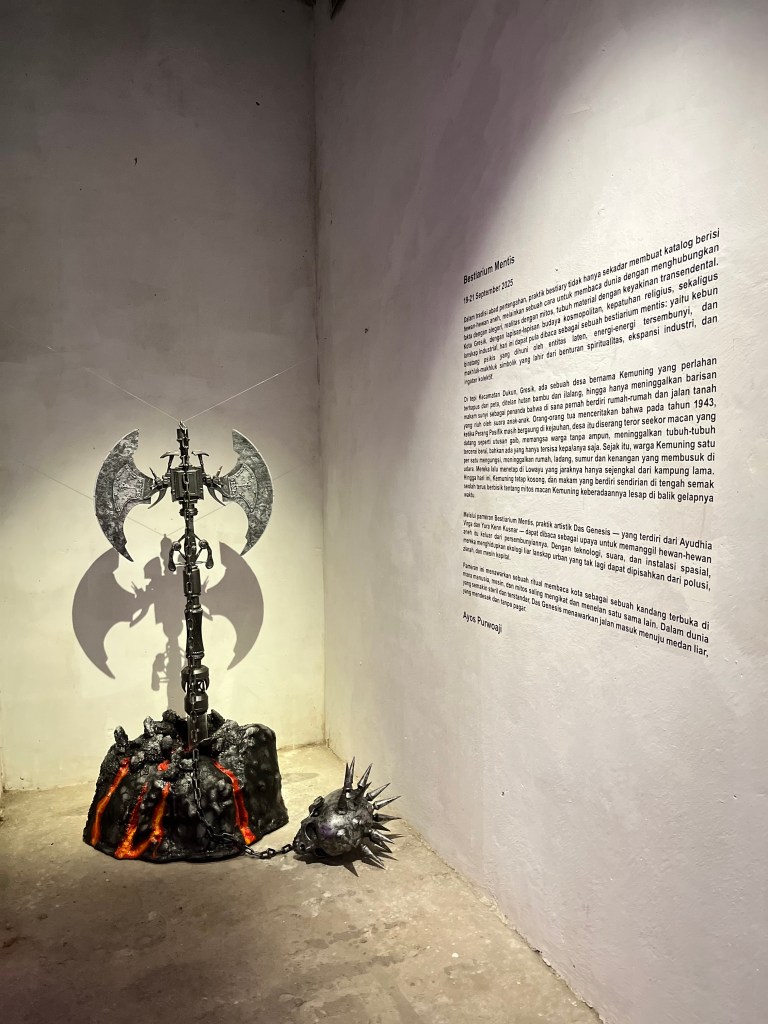
Positioned near the curatorial text, Ode to Acton is a 3D-printed sculpture featuring an axe and a mace bound to a dual-faced skull. The mace pierces a melting, lava-like stone. Visually striking, the work compels attention even before its meaning is unpacked.
According to its caption, the axe—a symbol of violence and authority—becomes a hybrid metaphor for power beyond dominance or submission, residing instead in spaces of tension where rules falter. This echoes Ayudhia’s observation of Gresik’s architectural coexistence.

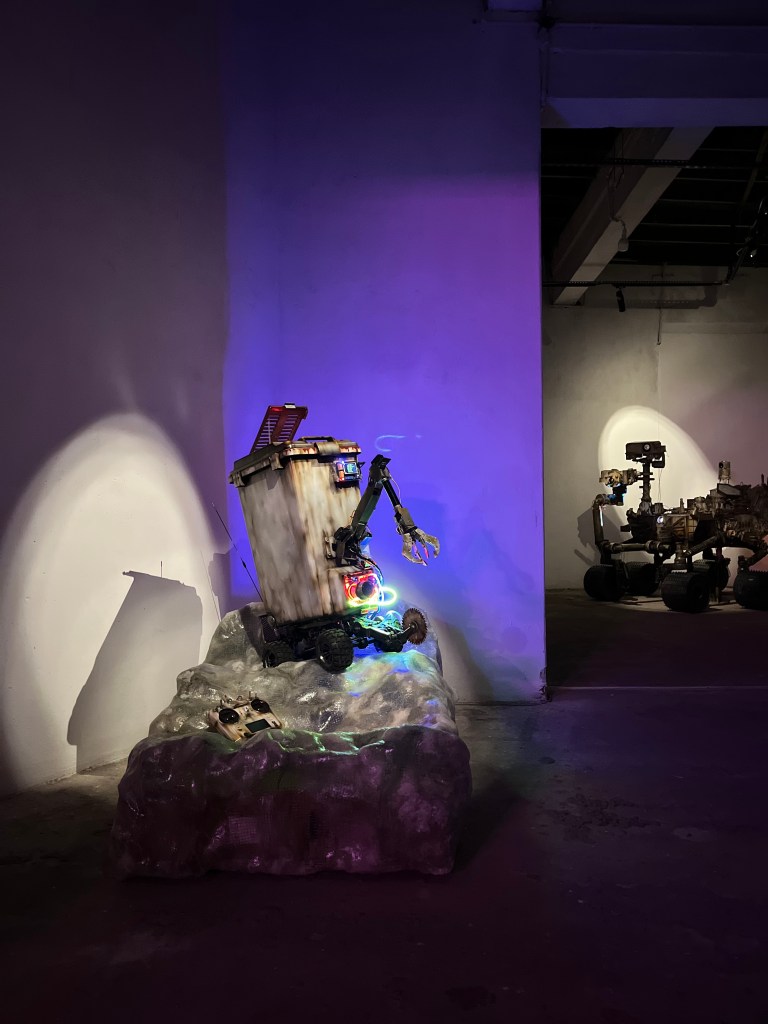
Nearby stands Lakai, a wheeled machine with a mechanical arm and circular saw. Ayudhia explained its philosophical grounding in Heidegger’s concepts of zuhandenes (ready-to-hand) and vorhandenes (present-at-hand). Unlike ordinary tools, which cycle between utility and breakdown, Lakai lingers in the in-between state—refusing to be “fixed,” suspended in perpetual transition.
Mars Rover as Modern Golem
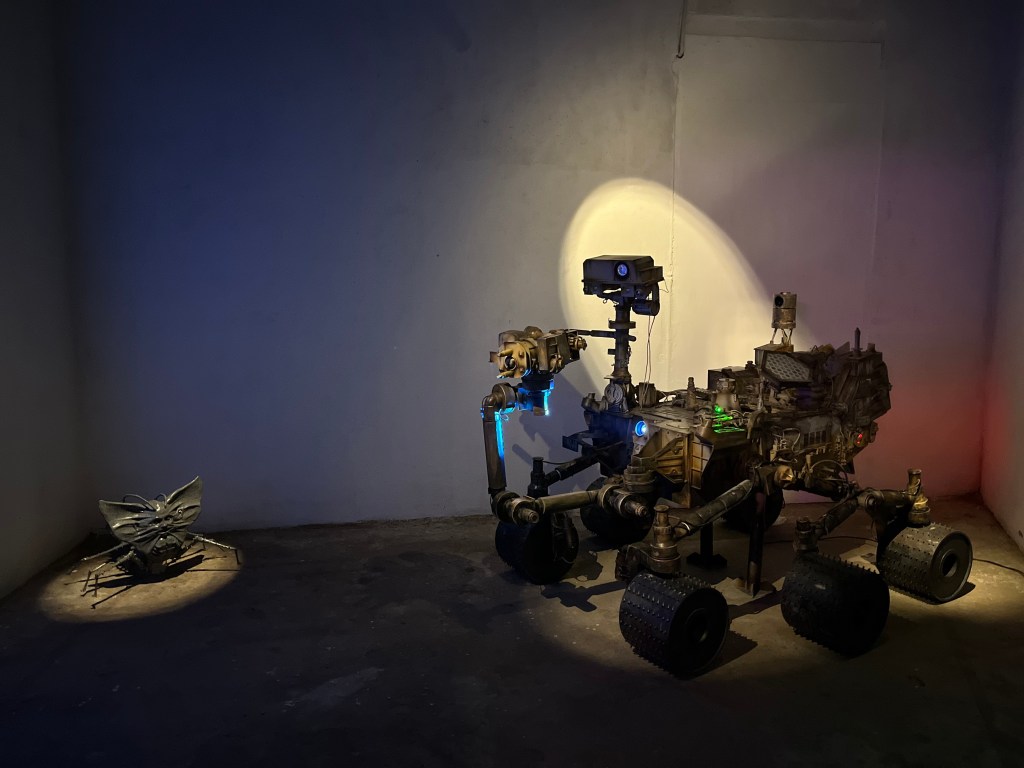
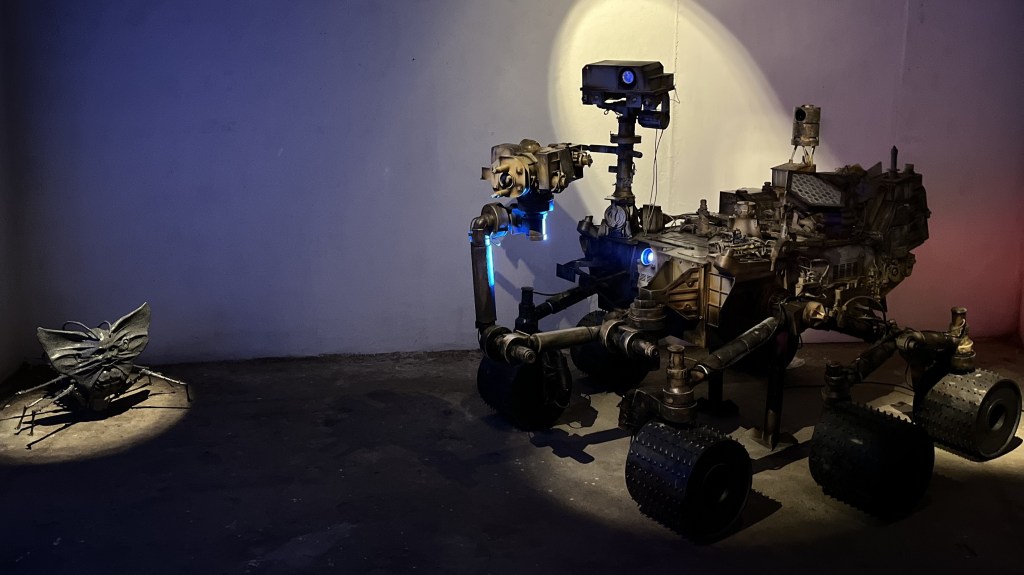
In the next room, Mars Rover as Modern Golem commands attention. The replica rover periodically shoots lasers onto a wall displaying its caption. The reference to the mythical golem—a clay guardian from Jewish tradition—invites reflection on humanity’s artificial creations: powerful yet soulless, protective yet dangerous.
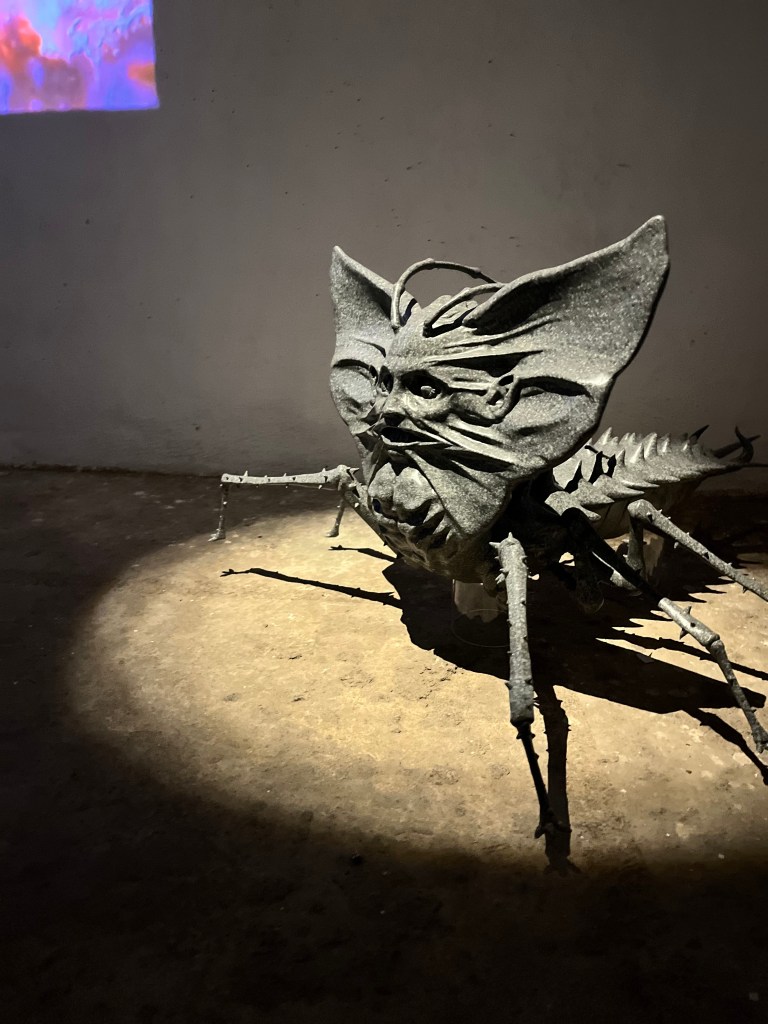
Ayudhia explained that the rover references a NASA craft lost on Mars. Here, it encounters a being called Proplastus Nihili (“God’s draft creature”), hidden within its drawer—something humans were never meant to see. The piece reflects human ambition in creating life-like machines governed not by spirit but by code.
Nearby, the animated video When Layers Learn to Breath depicts shifting physical and non-physical strata fusing into explosive new forms. This synthesis embodies new media logic: not static representation but continuous transformation, where difference breeds radical new digital entities.
Concluding Work and Music Performance
The final installation features a toy duck perched on a tripod, set atop stacked red bricks and illuminated by a looping animation. Its juxtaposition of innocence and dystopia—sweetness clashing with unease—creates a surreal, magical effect, amplified by its soundscape.
The exhibition’s lighting design deserves mention: it enhanced dimensionality across works and lent drama to the experimental music performance the following evening.
During that performance, Loteng Gallery’s lack of AC became part of the design. The deliberate heat pushed the audience toward fans, redistributing them across the space. As Ayudhia explained, this discomfort was intentional, reshaping how people inhabited the performance.
Conclusion
Bestiarium Mentis can ultimately be read as an attempt to summon hidden beasts through technology, sound, and spatial installation—resonating with the 11th East Java Biennale’s theme of conjuring The Specter of the Sea (Hantu Laut).

 readesignmagazine.com
Leave a comment