
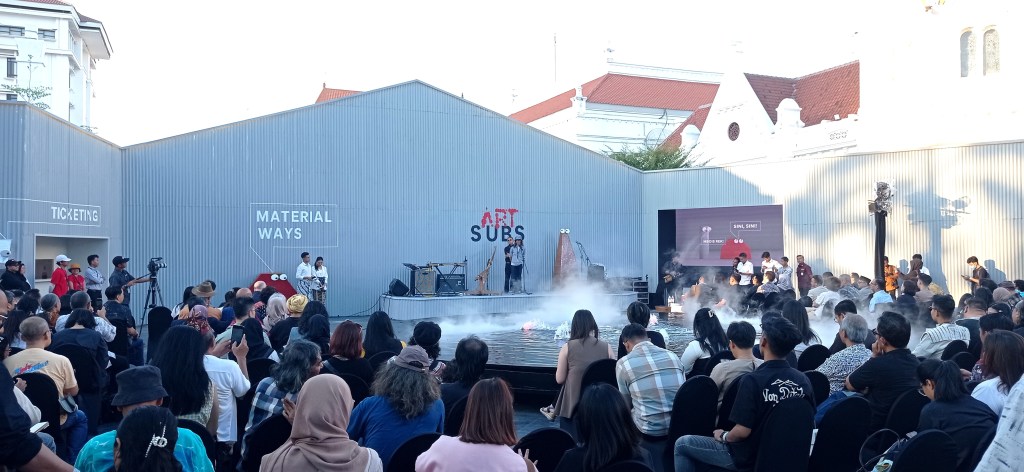
ART | EXHIBITION | SURABAYA | 2025
By Dimas Tri Pamungkas.
The 2025 ARTSUBS contemporary art exhibition, titled ‘Material Ways’, signals a strong tendency in the contemporary Indonesian art landscape: the return of material as a subject of ideas. The exhibition features over 120 artists from various regions, employing cross-medium approaches from textiles and glass to technology-based media such as video art, Augmented Reality, and artificial intelligence. Amidst the deluge of digital imagery and visual information, ARTSUBS seems to assert that material remains an articulated field that is both the most radical and the most unfinished. However, the question remains: does this exhibition truly transcend the paradigm of material as a symbol, and enter an ethico-onto-epistemological space where objects possess the agential power to shape meaning and the world?
Through the lens of Karen Barad’s theory (2007) and the framework of New Materialism as explained by Coole and Frost (2010) and Dolphijn and van der Tuin (2012), the observer’s position shifts from subject-centrism toward a configuration where humans, objects, space, and representation are interacting actors in an intra-active manner. Barad (2007) rejects the dichotomy between subject and object, introducing the idea that phenomena do not precede relations but are formed from intra-action. Unlike interaction, which assumes entities are whole before they relate, intra-action emphasizes that the identity of a human, an object, or an idea is formed through relational entanglement.
If so, then art is not merely a form of human communication that uses material as a medium but is a configuration of intra-action among artists, objects, technology, institutions, space, and visitors. Barad (2007) provides a theoretical tool for reading artworks not as symbolic representations of grand ideas but as material events that help shape social and ontological conditions. In the context of ARTSUBS, this means materials—be they glass, soil, sound, or digital data—are no longer subordinate to conception but become part of the production of meaning itself.
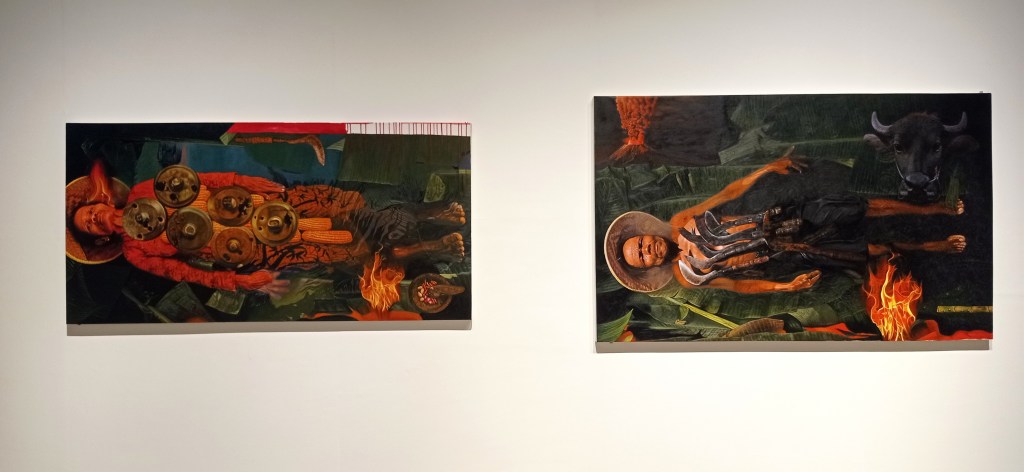
Several works in this exhibition reinforce this perspective. Moelyono’s two works, Gamelan Mengapung di Ladang Jagung (Gamelan Floating in a Cornfield) and Arit Mengapung di Ladang Tebu (Sickle Floating in a Sugarcane Field), for example, can be read as a dynamic field of intra-action between humans, objects, and the agrarian landscape. This approach aligns with Bennett’s (2010) idea of vibrant matter, which views material not as a passive tool but as an active entity that shapes social-political reality. In Gamelan Mengapung di Ladang Jagung, the bodies of farmers, the corn, and the gamelan instruments form a material network that mutually affects one another—the sound of the gamelan builds a cultural resonance inherent to the agricultural cycle, while the corn restores a narrative of collective labor threatened by industrial homogenization. Meanwhile, Arit Mengapung di Ladang Tebu places the sickle—a symbol of labor and class struggle—on par with the bodies of farmers, fire, sugarcane, and buffalo, forming an egalitarian material ecology.
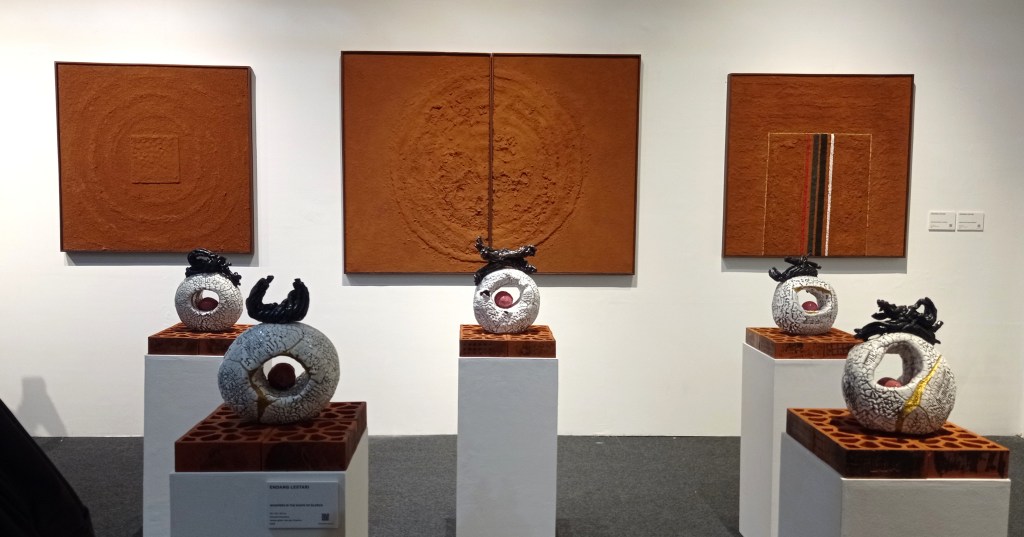
Sediment of The Soul by Endang Lestari moves within a similar framework. The clay material, with its brick-red color and texture, becomes an active actor that stores geological history and collective memory. This perspective is consistent with Bolt (2013), who emphasizes the performative power of images and objects. The cracks in the ceramic hint at a physical process—heat, pressure, cooling—that becomes the material narrative itself, forming a dialogue between natural forces and human intervention. Within the New Materialism framework (Coole & Frost, 2010), this work challenges the mind-matter dichotomy, asserting that the “soul” is not outside matter but is materialized through the intra-action of soil, fire, and form.
However, a deeper look reveals that ARTSUBS still retains a strong problem of representationalism. Many works still use material as a narrative vehicle for grand ideas such as ecology, consumption, trauma, or digitalization. This aligns with Barad’s (2007) critique of the dominance of representation, which asserts that meaning is born from ever-changing material relations, not from an idea poured into a medium.
Another issue is the distribution of agency in the curation. Latour (2005) reminds us that non-human actors such as space, lighting, and display have a significant influence in shaping the experience of a work. In some exhibition spaces, the arrangement is still hierarchical—giving certain works a special stage while marginalizing others—creating an intra-active relationship that affects the final meaning of the work.
This question is important because, as Barad (2007) emphasizes in her concept of onto-epistemology, the ways we know, become, and are accountable are inseparable. An art exhibition is not just a space for appreciation but an ethical field that requires an awareness of the relations between objects, bodies, and space.
In the context of ARTSUBS, waste-based works are often used to critique society but do not touch upon the structure of the art economy itself. Morton (2013), in his idea of hyperobjects, reminds us that ecological phenomena cannot be reduced to mere symbols but must be confronted in their inescapable existence. Plastic curated with high aesthetics risks falling into a capitalistic aestheticization of disaster.
This is where it is important to distinguish between “material critique” and “representational critique of material.” Grosz (2001) and Bennett (2010) show that the material paradigm can challenge the dominance of ideas if the relations of object-body-space are directly questioned. ARTSUBS has the opportunity to become a space for material critique, but for now, it still leans towards representationalism.
Nevertheless, this exhibition remains important because it shows the push and pull between old and new paradigms. It indicates a symptom of a transitional understanding of art from representation toward a material configuration that produces reality. As Dolphijn and van der Tuin (2012) remind us, this transition is a crucial moment for forming new ways of thinking about art and materiality.
Ultimately, ‘Material Ways’ is an unfinished field. It is full of cracks, remnants, and reflections, inviting us to listen to the world from a different direction—from the sound of broken glass, plastic that won’t decompose, clay that holds the heat of fire, gamelan floating in a cornfield, and sickles hovering in a sugarcane field. Releasing the supremacy of the mind over objects is a step toward art as an ontological, not merely an aesthetic, event.
References
Barad, K. (2007). Meeting the Universe Halfway: Quantum Physics and the Entanglement of Matter and Meaning. Durham: Duke University Press.
Bennett, J. (2010). Vibrant Matter: A Political Ecology of Things. Durham: Duke University Press.
Coole, D., & Frost, S. (2010). New Materialisms: Ontology, Agency, and Politics. Durham: Duke University Press.
Dolphijn, R., & van der Tuin, I. (2012). New Materialism: Interviews & Cartographies. Ann Arbor: Open Humanities Press.
Bolt, B. (2013). Art Beyond Representation: The Performative Power of the Image. London: I.B. Tauris.
Grosz, E. (2001). Architecture from the Outside: Essays on Virtual and Real Space. Cambridge: MIT Press. Latour, B. (2005). Reassembling the Social: An Introduction to Actor-Network-Theory. Oxford: Oxford University Press.
Morton, T. (2013). Hyperobjects: Philosophy and Ecology after the End of the World. Minneapolis: University of Minnesota Press.
 readesignmagazine.com
Leave a comment