
ART | FILM | SURABAYA | 2025
Mr. Ahmad is a very, very talented artist. We had a lot of questions today on ‘Do you think the market will follow you?’ He said, ‘I’m not here to think about that. I’m here to create.’ And this, truly, is the key.” – Jules Irrmann, Director of Institut français Indonésie.
A kinetic installation by Waftlab collective artist Mukhamad Aji Prasetyo, titled Corrosion Mutation, is showcased in the atrium area of Orasis Art Space. Aji created this work after realizing the absence of the dragonfly population, a familiar sight from his childhood memories, upon returning to his hometown in Jombang. The presence of dragonfly populations, especially certain types, is generally a sign that an ecosystem – particularly its waters – remains pristine and unpolluted.
Crafted from materials commonly associated with industrial imagery like iron, wire, and strobe lights, the dragonflies in Corrosion Mutation are suspended over an area dense with vegetation. Their eyes illuminate whenever visitors trigger the work’s sensors.

The waning of the dragonfly population in Jombang parallels the industrial growth in the area. Through this work, a critical question arises: “What if these dragonflies signify an already damaged environmental ecosystem, rather than a healthy one?”
Now in its second year, Kinekini has been retitled ‘Moving Image Screening,’ moving away from ‘Film Screening.’ This change reflects that moving image works encompass more than just traditional films, also including creations like the Corrosion Mutation kinetic installation, which is a dynamic moving image piece. Such works are presented at Kinekini with the intention of redefining cinema.
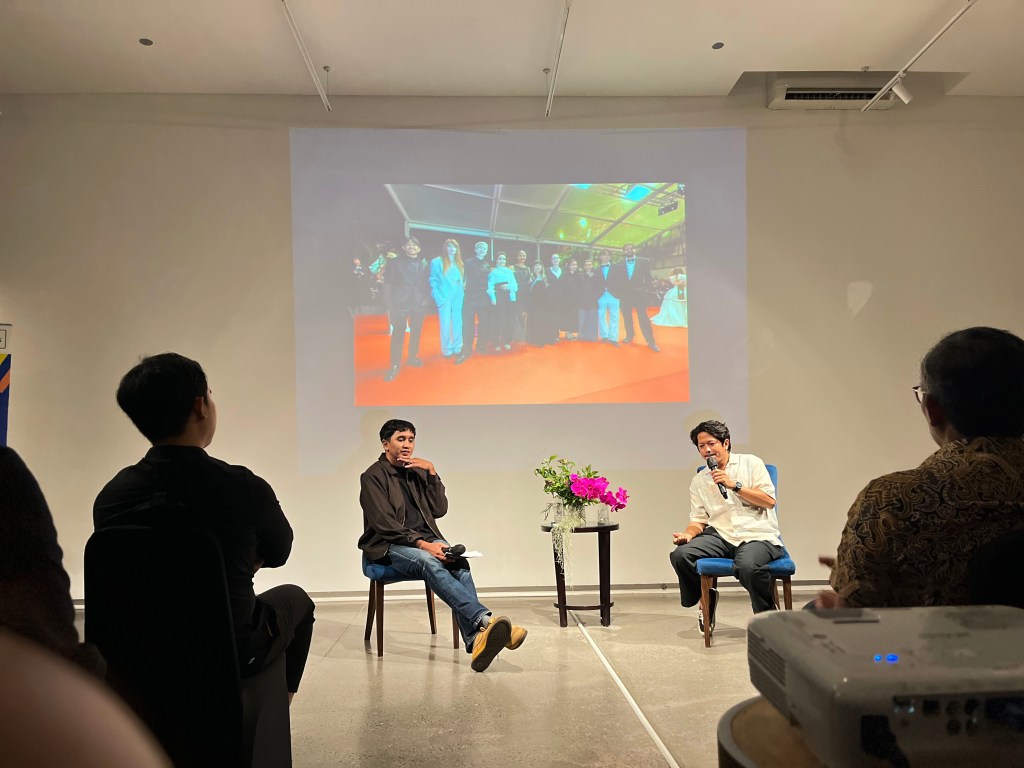
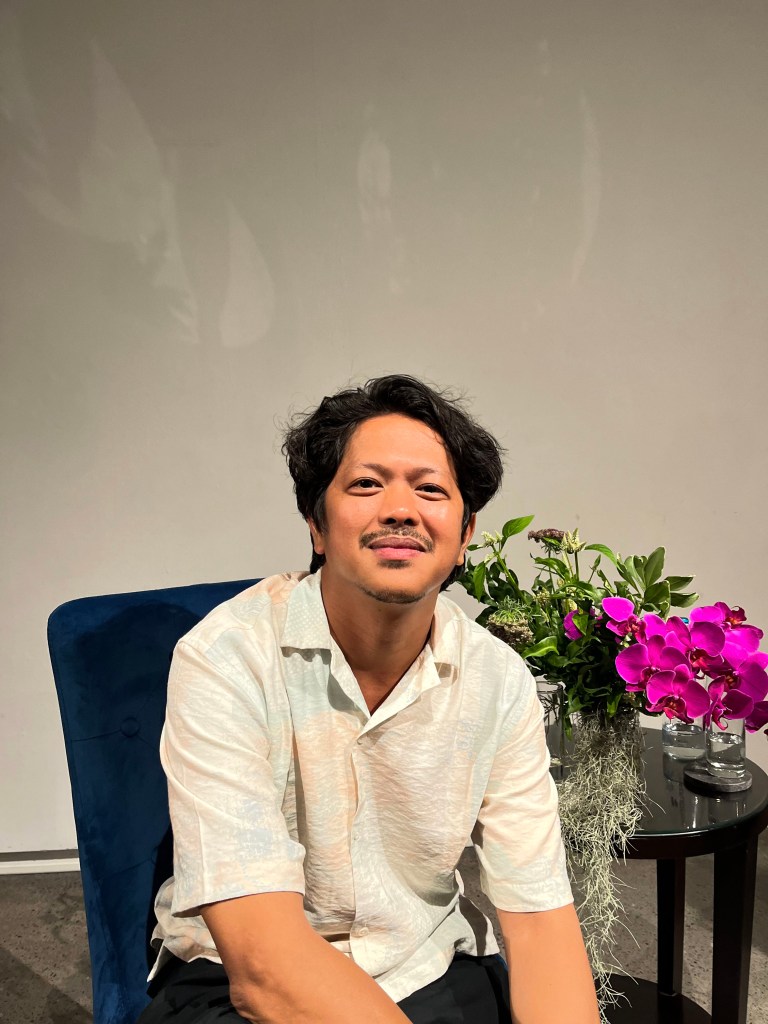
On June 4, 2025, Kinekini hosted a moving image screening featuring director Aditya Ahmad, which was followed by a director’s talk. Aditya Ahmad was selected by Kinekini curator Taufiq Hariyadi, a representative of Screenpills, due to his recent residency in Paris last year and his role as a significant link between Indonesia and France. As in previous years, Kinekini Moving Image Screening 2025 is supported by IFI Surabaya.
About the Filmmaker
Born in 1989, Aditya Ahmad is an Indonesian director and writer. He completed his studies at the Makassar Institute of Arts in 2013, where his short film ‘Sepatu Baru’ / On Stopping the Rain served as his final project. This film earned a Special Mention from the Children’s Jury Generation KPlus at the 64th Berlin International Film Festival (2014).
Since 2013, Aditya has contributed to various film and TV commercial projects. He also participated in prestigious programs such as the Asian Film Academy in 2014 and Berlinale Talents in 2015. His short film, ‘Kado’ / A Gift, world-premiered in the Orizzonti Short Films Competition at the 75th Venice International Film Festival in 2018, ultimately winning the Best Short Film award. He is currently writing his debut feature film.
In 2024, he was selected as a participant in La Résidence. This program, organized by Cinéfondation as part of the Festival de Cannes series, is dedicated to film script development. One of Aditya’s key activities during the residency was presenting his first feature film project, titled Goldfish, at the La Résidence Pitching Showcase.
About the Films
Three of Aditya Ahmad’s short films were screened as part of a special ‘Focus On: Aditya Ahmad’ session. These included ‘Pagar’ /Fence, ‘Sepatu Baru’ / On Stopping the Rain, and ‘Kado’ / Gift.
Created in 2006 during a filmmaking workshop at a modern Islamic boarding school in Makassar, ‘Pagar’ is a film by Aditya Ahmad from his high school years. The film’s narrative stems from his personal frustration as a boarding school boy with a passion for soccer. His love for the PSM Makassar soccer club was obstructed by a fence. This fence carries a dual meaning: literally, it is the boarding school fence that separated him from the outside world; symbolically, it represents the rules that restricted him from pursuing his interests during that period.
His second film, ‘Sepatu Baru’ / On Stopping the Rain, served as his graduation project from the Makassar Institute of Arts in 2013. This film revolves around a child who receives new shoes, only to face the dilemma of them getting wet and dirty amidst rain and floods. The narrative explores how the main character endeavors to stop the rain, hoping to wear his pristine new shoes outdoors for the very first time.
Released in 2018, ‘Kado’ / Gift is a perfectly crafted, 15-minute short film that offers a profound and nuanced story about the modern complexities of gender identity. The main character, Isfi, navigates social expectations: she can comfortably wear pants among her male friends but must don a hijab to be respectfully present at Nita’s house. With Nita’s birthday two days away, Isfi’s sole desire is to prepare the perfect gift for Nita in Nita’s room.
Director’s Talk with Aditya Ahmad
Taufik (Curator): “I chose the film ‘Pagar’ because I think your vision, as conveyed by the camera placement, in this film is very interesting. Has this film been shown before, other than at this event?”
It was last screened at the Bamboo Film Community in Jakarta in 2008. Produced in 2006, this film was made when I was in my second year of high school at a modern boarding school in Makassar. This was actually an accidental introduction to the medium of film. Previously, I was not familiar with cinema. I grew up watching films on television; I was not born into a family that had a culture of watching films in a movie theater.
Taufik (Curator): How’s it going with the folks in the film community in Makassar today?
It’s growing. And it’s not just about films, actually. My friends and I in the Makassar film community are committed to creating good work. We never aim to take our work to festivals. There’s a real pleasure when we try something and it works. We’re primarily focused on experimenting. For example, we might think: ‘What if we create a visual like this and incorporate an actor?’
Taufik (Curator): Do you have any aesthetic compass about youth personality that you want to deliver to the public?
I actually had no initial intention of making a coming-of-age film or a teen film. However, without realizing it, questions began to emerge from my own teenage years. Teenagers are no longer children, but they aren’t quite adults either. During this period, many fragile but genuine questions about self-identity arise: ‘Who am I?’ ‘Why am I here?’ This is why I wanted to revisit those questions that emerged during my adolescence, and perhaps the story will organically emerge from those unresolved inquiries.
Taufik (Curator): When you write, do you plan your work in advance, or do you write some of it and then leave room for development during the editing process? What is your usual writing approach?
I never start with something grand or a predefined theme. I never really know what the ultimate subject will be. Instead, I always begin with questions. For instance, with the film ‘Sepatu Baru’ / On Stopping the Rain, the process was incidental. Since it was the rainy season, I sought a story set in a rainy environment. Then I recalled a family anecdote: they once considered throwing away their underwear to ensure a wedding party would be crowded with guests because it wasn’t raining. I wanted to explore this from a child’s perspective, specifically how children understand their relationship with nature.
The film ‘Kado’ / Gift, on the other hand, was born from questions about my own existence as a human being. I was deeply introspecting about myself, including my career choice as a filmmaker. In the midst of my confusion and depression, I reunited with Isfi, the lead actress from the film ‘Sepatu Baru.’ When we reconnected after a long time, she posed many questions about her own identity, and these inquiries became the genesis of ‘Kado’ / Gift. Notably, everyone in ‘Kado’ / Gift plays themselves. These two films, ‘Sepatu Baru’ and ‘Kado,’ utilized distinct shooting processes and methods.
Sandra Vivier (Director of Institut français Indonésie Surabaya): “The three films depict the world through the eyes of children and teenagers, and I wanted to know more. Could you elaborate on why you are so focused on the vision of the world of the young ones?
I had many questions when I was young, and I believe I haven’t fully processed them yet. Those youthful questions still resonate with me. I simply wanted to revisit my past self, my youthful feelings and experiences, to re-engage with them and try to understand them better.
Vini (Readesign Magazine): I’d like to follow up on your media interview before the screening, specifically about your residency in Paris. You mentioned that you often walked around the city during that time. From those walks, were there any subtle details of the city’s nooks and crannies or the daily lives of its people that particularly caught your attention and inspired you?
Paris offered me the space to reflect on myself, to gain perspective, detached from my familiar surroundings. The residency allowed me to take a much-needed break. I truly loved living in Paris, and I appreciated who I was there. Despite being a bustling city, I could even sleep on the grass in its parks. Furthermore, the fact that it’s home to many of history’s great artists meant every corner of the city profoundly intrigued me.
Jessie (Audience): What kind of teenager are you trying to portray through the medium of photography? I’m particularly curious about this because teenagers exhibit such a wide range of differences. Could you elaborate on your perspective regarding teenagers and their relationship with photography?
I never operate with a fixed formula or pattern. Rather than starting with a predetermined narrative, I try to understand the story first. I ask myself: ‘Who do I want to portray?’ — a question whose answer I’ll discover later. My process involves truly seeing them: determining how I want to perceive them, from what angle, and how closely I want to engage with them. It’s more than simply taking pictures or shifting from scene to scene, or shot to shot. It’s about understanding the core intention of the story and the character I am portraying. Fundamentally, my approach as a creator is one of observation.
Audience: Are there any new goals that you want to achieve? Because I saw that the productions that you delivered are really from the perspective of the audience, which I really want to be enthusiastic about. Do you think market will follow?
As a director, I’m not here to think about that. I’m here to create.
In Conversation with Jules Irrmann
Readesign Magazine had the opportunity to interview Jules Irrmann, Director of Institut Français Indonésie.
“How do collaborations like KINEKINI contribute to IFI’s vision in Indonesia, especially in promoting French cinema and supporting local talents like Aditya Ahmad?”
First, I would just like to draw a general picture. As you may have seen in the media, the French President visited Indonesia. Aditya Ahmad was invited by the President for a state visit, during which he spoke extensively. The French Minister of Culture also accompanied the President to Indonesia, where she met with her counterpart, Fabrizio, and also with the Minister for Creative Economy. The President visited Borobudur to pay tribute to Indonesian civilization, but also engaged with the younger generation—the Indonesian new wave of the creative economy—including film, design, fashion, video games, and gastronomy. These are very important sectors for us.
The two presidents adopted a declaration on the Franco-Indonesian cultural strategy. This is crucial as it outlines a strategy of genuine partnership. The core idea is that France and Indonesia work together, not separately, to enhance Indonesian soft power in France and French soft power in Indonesia through collaborative, win-win programs.
Let’s take cinema as an example. We are organizing, and indeed organized last year at the Jogja-NETPAC Asian Film Festival (JAFF), a significant event. Notably, last year marked the first JAFF market, a new initiative for the festival. In partnership with the Ministry of Culture and APROFI, the Producers’ Federation, we organized the Indonesian-French Film Lab. This is a mentoring program for young Indonesian professionals, who received advice from French producers, professionals, and film directors.
The idea is to facilitate an exchange on how to better approach the French market. Following this, we will organize producers’ meetings in Paris to improve co-productions. Our efforts extend beyond merely promoting French cinema in Indonesia and supporting Art House Cinema.
Aditya Ahmad is a very, very talented artist. We had a lot of questions today on, ‘Do you think the market will follow you?’ He said, ‘I’m not here to think about that. I’m here to create.’ And this, truly, is the key. This aligns with our system in France, which features a comprehensive support and financing structure for artists. In fact, it is often the artist who creates the market, rather than the market dictating the artist’s output, as true creation would otherwise be stifled.”
“Beyond individual artists, how does IFI aim to strengthen Indonesia’s overall film ecosystem, fostering synergy between local talents, art spaces, and international institutions?”
Building on what I’ve said about the Indonesian-French Film Lab, this is one approach we will further develop. We will also involve leading French educational institutions such as La Fémis, widely regarded as the best film school in France. They will visit Yogyakarta, and this summer, we will also send a student to La Fémis in France for a summer course.
Similarly, in animation, France boasts Le Gobelins, one of the world’s premier animation schools. Thus, we will also enhance educational cooperation for young, aspiring professionals.
For young professionals, we will further refine our existing initiatives. We will expand our efforts within the framework of Indonesian initiatives, maintaining our collaborative approach with APROFI and the Ministry of Culture. This truly must be a partnership. Because, once again, our focus is not solely on showcasing France in Indonesia. To foster deeper understanding, we must also showcase Indonesia in France, working towards a richer mutual appreciation of our cultures.
It is crucial to facilitate this exchange, not merely by presenting France, but by building bridges and fostering dialogue among professionals. When trust is established and friendships are formed, genuine collaboration follows, leading to improved co-production, enhanced creativity, and closer bonds between people. This collaborative spirit is truly the key for fostering future talent.
 readesignmagazine.com
Leave a comment